
When a Percolation Test Changes Site Development Plans
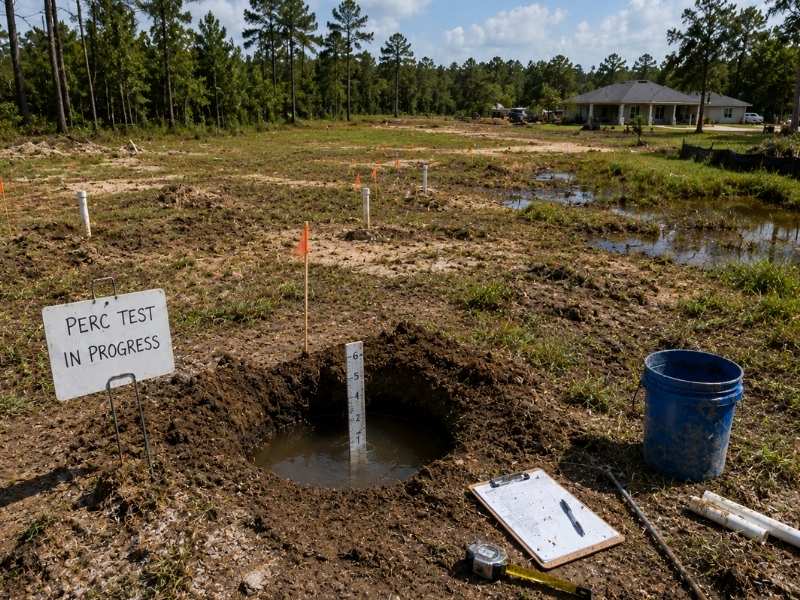
A percolation test can shrink your buildable area before you’ve poured a single foundation. Developers often treat it as a formality, something to check off between the survey and the permit application. It’s not. A failed or marginal percolation test can force a full site redesign, and the earlier you find that out, the less it costs you.
Here’s how a percolation test can reshape your plans, and what to watch for before it happens to you.
Why Slow Soil Absorption Can Shrink the Buildable Area
A percolation test measures how fast water soaks into the soil. Slow absorption means the ground can’t handle wastewater the way a septic system needs it to. When that happens, the area suitable for a drainfield gets smaller, sometimes by a lot.
This is where site plan redesign can become necessary, because the original building footprint may no longer work once poor soil absorption removes part of the usable land.
This matters because drainfields need specific soil conditions to work safely. If the soil on part of your lot absorbs too slowly, that section gets ruled out. The buildable footprint you planned around might not hold up once the test results come back.
What to do:
- Order the percolation test before finalizing your site plan, not after.
- Ask the tester to map exactly which zones passed and which did not.
- Build flexibility into your early layout in case part of the lot gets excluded.
How Septic Suitability Can Shift the Entire Site Layout
A site plan usually starts with the house or building placement first. But if the property relies on a septic system, the order should flip. Septic suitability, driven by the percolation test, often has to come first, because it decides where the drainfield can legally sit.
Once that area is locked in, everything else has to work around it. Setbacks from the drainfield, distance requirements from wells or water bodies, and access for future septic maintenance can all push your building footprint into a different spot than you first imagined.
What to do:
- Run the percolation test early enough to inform your layout, not confirm one you already drew.
- Identify the required setback distances from your local health department before finalizing any placement.
- Treat the drainfield location as a fixed point, then design around it.
Why Drainfield Placement May Control More Than the House Location
A drainfield doesn’t just need its own space. It needs protection from disturbance, which means driveways, parking areas, and even some landscaping choices have to steer clear of it. Heavy equipment driving over a drainfield can compact the soil and ruin its ability to function.
This is where developers get caught off guard. They plan a driveway route or a parking layout without checking where the drainfield sits, then find out during review that the two conflict.
What to do:
- Get the drainfield location marked on your site plan before designing driveways or parking areas.
- Avoid placing any heavy traffic route across or near the drainfield zone.
- Check local rules on minimum setback distances between the drainfield and hardscape features.
How Failed Perc Results Can Force Redesign Before Permitting
A failed percolation test doesn’t always mean the project is dead. It usually means the plan needs to change. That could mean shifting the building footprint, reducing the number of units on a residential development, or installing an alternative septic system designed for poor soil conditions.
Alternative systems cost more and often require additional approvals. Developers who don’t budget time or money for this possibility can find their permitting timeline stretched by months.
What to do:
- Ask your soil tester what alternative septic options exist if the standard test fails.
- Get a rough cost estimate for alternative systems before you’re forced to choose one under time pressure.
- Build a contingency budget into your project in case redesign becomes necessary.
Why Soil Saturation Patterns Matter More Than Lot Size
A large lot doesn’t guarantee good soil. Saturation patterns, meaning how water moves and pools underground across different seasons, can make even a spacious property unsuitable in certain sections. Florida’s water table sits close to the surface in many areas, which makes this especially relevant for site planning.
Developers sometimes assume more acreage means more flexibility. That’s not always true. A percolation test conducted during a dry season can also miss saturation issues that show up later, which is why timing and thoroughness matter.
What to do:
- Ask if seasonal high water table data is available for the site, not just a single test result.
- Consider testing during different times of year if the project timeline allows it.
- Don’t assume a large lot solves a soil problem. Confirm it with data.
What This Means for Your Next Site Plan
A percolation test can reshape a development plan more than most developers expect going in. Slow absorption, septic suitability, drainfield placement, failed results, and seasonal saturation all play a role in what you can actually build and where. Run the test early, treat the results as a design input rather than a formality, and budget time for a possible redesign. It’s far cheaper than redesigning after permitting has already started.
Frequently Asked Questions
How long does a percolation test usually take to complete?
Most tests take a few hours to a full day for the fieldwork, although full analysis and reporting can take one to two weeks depending on the local health department’s review process.
Can a property fail a percolation test and still be developed?
Yes, in many cases. An alternative septic system designed for poor-draining soil can sometimes make the site workable, although it usually costs more and requires added approvals.
Does a percolation test need to be redone if a project is delayed for several years?
Often, yes. Soil conditions and local health department requirements can change over time, so an outdated test may not be accepted for a new permit application.
Is a percolation test required if the property will connect to a public sewer system?
Usually not, since the test is specifically used to evaluate soil suitability for septic systems. Properties on public sewer typically skip this step.
Can weather conditions affect percolation test results?
Yes. Testing during an unusually dry or wet period can produce results that do not reflect typical year-round soil conditions, which is why seasonal data matters for larger projects.
