
What to Request in a 2026 ALTA Survey (New Standards Explained)
A compliant 2026 ALTA/NSPS survey request requires four key elements: a clear reference to the 2026 standard, a current title commitment, all recorded property documents, and selected Table A items. Missing any of these can delay approval, trigger revisions, or result in lender rejection.
The updated standards took effect on February 23, 2026. If you’re ordering an ALTA survey today, following these requirements upfront is critical to avoid delays and keep your transaction on track.
What Are the 2026 ALTA/NSPS Standards?
The 2026 ALTA/NSPS standards define how ALTA Land Title Surveys are performed across the United States, ensuring consistency for lenders, buyers, and title companies.
They establish requirements for:
- Property boundaries
- Easements
- Improvements
- Access and encroachments
These standards are issued by the American Land Title Association (ALTA) and the National Society of Professional Surveyors (NSPS), creating a uniform framework for commercial real estate due diligence.
What Changed in the 2026 ALTA Standards?
The 2026 update removes ambiguity by requiring all survey scope elements to be clearly defined before work begins. This eliminates assumptions that previously caused delays and revisions.
Key changes include:
- Survey requests must explicitly reference the 2026 standard
- Table A items must be selected upfront
- Supporting documentation is fully required at the start
- Review processes are more standardized
In practice, this results in fewer revisions, faster lender approvals, and less back-and-forth during transactions.
What Must You Request in a 2026 ALTA Survey?
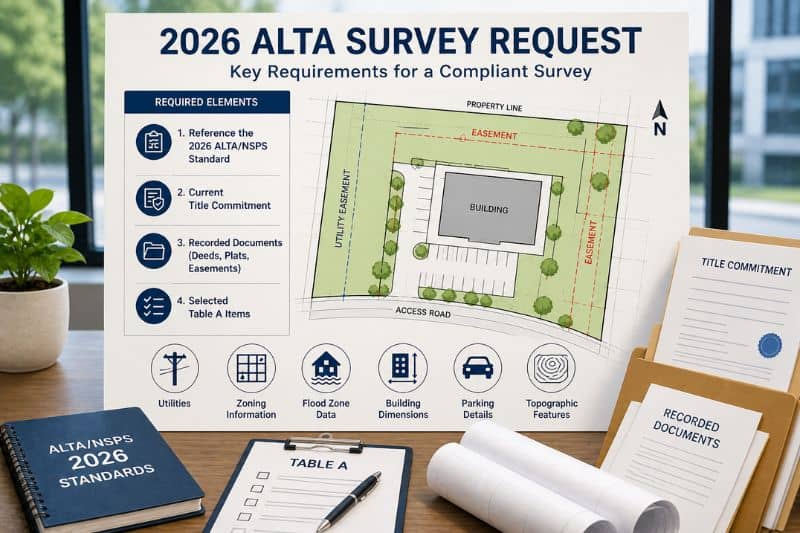
A compliant 2026 ALTA survey request must include four key elements: a clear reference to the 2026 ALTA/NSPS standard, a current title commitment, all relevant recorded property documents, and selected Table A items. Missing any of these can delay approval or cause lender rejection.
To avoid issues, your request should include:
- An explicit reference to the 2026 ALTA/NSPS standard
- A current title commitment
- Recorded documents (deeds, plats, easements)
- Selected Table A items
If any of these are missing, the surveyor may pause the project or deliver a survey that does not meet lender requirements. Each component directly impacts survey accuracy, lender approval, and overall timeline reliability.
Why Do the 2026 Standards Matter?
The 2026 standards matter because most survey delays are caused by incomplete or unclear requests, not fieldwork errors.
When the request is complete:
- The survey is accepted the first time
- Lender review moves faster
- The closing schedule stays intact
When it’s incomplete:
- Revisions are required
- Closing gets delayed
- Costs increase
In commercial transactions, missing documentation or unclear scope can add 5 to 15 days to the timeline, which is often enough to disrupt financing or push closing dates.
What Happens If You Don’t Specify the 2026 Standard?
If the 2026 standard is not clearly stated, the survey may not meet lender requirements and could be rejected.
Common outcomes include:
- Missing required elements
- Lender rejection
- Last-minute revisions
- Additional costs
For example, if a survey is completed under outdated assumptions, the lender may require revisions under the 2026 standard, forcing tight deadlines and delaying closing.
What Are the Most Common Mistakes When Ordering an ALTA Survey?
Most ALTA survey delays come from avoidable coordination issues rather than technical errors.
Common mistakes include:
- Not specifying the 2026 ALTA standard
- Skipping Table A item selection
- Failing to provide a title commitment
- Assuming a “standard scope” applies
- Ordering the survey too late
Avoiding these mistakes significantly improves approval timelines and reduces project risk.
How Do You Request a 2026 ALTA Survey Correctly?
A proper 2026 ALTA survey request follows a clear, structured process that eliminates guesswork for the surveyor.
To submit a complete request:
- Define the purpose (purchase, refinance, or development)
- Clearly state the 2026 ALTA/NSPS standard
- Provide the title commitment
- Submit all recorded documents
- Select appropriate Table A items
- Order early
This ensures the survey is aligned with lender expectations from the start.
Which Table A Items Do You Need?
Table A items should be selected based on how the property will be used, not chosen at random.
Common Table A items include:
- Utilities
- Zoning information
- Flood zone data
- Building dimensions
- Parking details
- Topographic features
Typical selections vary by use:
- Developers: utilities and topography
- Lenders: zoning and flood data
- Buyers: access and easements
A large share of lender pushbacks is tied to missing or incorrect Table A selections.
Why Does Timing Matter in ALTA Surveys?
Ordering an ALTA survey early allows time to resolve issues before they impact the transaction.
When ordered early:
- Boundary issues are identified before design begins
- Easements are reviewed before planning decisions
- Documents can be corrected without pressure
When ordered late:
- Issues surface during closing
- Revisions happen under tight deadlines
- Timelines become compressed
Early coordination is one of the most effective ways to prevent delays.
Real-World Example of a 2026 ALTA Survey Workflow
A developer submits a complete request including the 2026 standard, title commitment, and selected Table A items.
During initial review, the surveyor identifies missing easement documents, which are resolved before fieldwork begins.
The result:
- No redesign during lender review
- No last-minute revisions
- A smoother, faster closing process
Why Are ALTA Surveys Required in Commercial Deals?
ALTA surveys are required because lenders and title companies rely on them to verify property conditions before financing.
They support:
- Title insurance underwriting
- Lender risk evaluation
- Legal property verification
- Consistent due diligence
Most financed commercial real estate transactions require an ALTA survey to move forward.
FAQ
Do I always need an ALTA survey?
ALTA surveys are typically required for commercial transactions involving lenders or title insurance. Most residential transactions use simpler survey types.
How long does an ALTA survey take?
Most ALTA surveys take several weeks. Timelines depend on property size, complexity, and how complete the initial documentation is.
What’s the difference between an ALTA survey and a boundary survey?
A boundary survey identifies property lines. An ALTA survey includes boundaries, easements, improvements, and title-related details required for commercial real estate transactions.
