
What Does a Construction Surveyor Do on a Building Project?
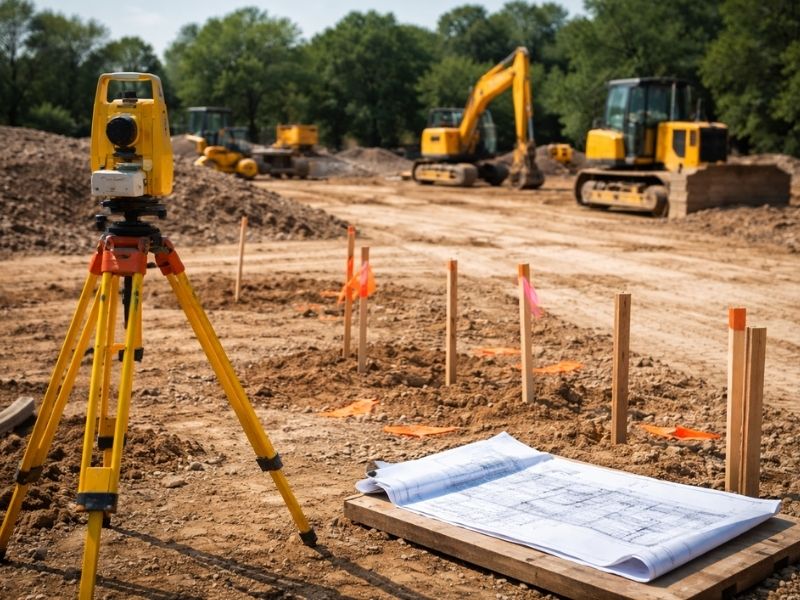
Builders and developers hire architects, engineers, and contractors before a shovel hits the ground. The one professional who often gets scheduled too late, or not at all, is the construction surveyor. That’s a costly mistake. A construction surveyor is active from the day site work begins through the day the building inspector signs off, and every phase in between has a specific task that only a licensed surveyor can complete correctly.
The Construction Surveyor’s Core Job
A construction surveyor translates approved design plans into physical points on the ground. The drawings show where a building should go, what elevation the finished floor needs to be, where utilities run, and how the site drains. The surveyor takes that information and puts it on the actual land so the crew knows exactly where to dig, pour, and build.
This work requires both horizontal control (the X and Y position of every element) and vertical control (the elevation or Z position). Get either wrong, and the consequences range from a failed building inspection to a foundation that has to be demolished and repoured.
A concrete foundation poured at the wrong elevation can cost $50,000 or more to demolish and correct. The form board survey that prevents it typically costs $400 to $1,200. The math is not complicated.
Phase 1: Pre-Construction Site Work
Before any grading or clearing begins, the construction surveyor establishes the control network for the entire project. This means setting reference points and benchmarks across the site that everything else will be measured from. These control points are the anchor for every subsequent survey visit.
At this stage, the surveyor also reviews the design plans and compares them against field calculations. If there’s a discrepancy between what the plans show and what actually exists on the ground, finding it before the crew mobilizes is far cheaper than finding it mid-construction.
Rough grading staking follows. The surveyor marks cut and fill limits, drainage flow lines, and elevation targets so the grading contractor knows where to move earth and to what finished grade.
Phase 2: Construction Staking
Once the site is prepared, construction staking begins. This is the phase most people associate with a construction surveyor: placing stakes and flags on the ground to show the crew where to build.
Stakes mark:
- Building corners and foundation lines
- Setback limits from property lines
- Utility corridors for water, sewer, gas, and electrical
- Road centerlines, curb lines, and pavement edges
- Retaining walls, grading limits, and drainage features
Each stake carries information: a description of what it represents, an offset distance if needed, and an elevation reference. The crew uses this to position every element of the project correctly.
Staking happens in phases tied to the construction schedule. Rough grading staking comes first, followed by utility layout, then building corners, then fine grading as the project progresses. The surveyor returns at each phase.
Phase 3: The Form Board Survey
Before concrete is poured for a slab foundation, the construction surveyor performs a form board survey (also called a foundation survey). This is one of the most time-sensitive tasks on any residential or commercial project.
After the contractor sets the wooden forms that will contain the concrete, the surveyor measures the top of each form board and compares it to the elevation specified in the engineering plans. If the forms are too low, the finished floor won’t meet flood zone requirements and the building may not pass inspection. If they’re too high, drainage, ramp grades, and ADA compliance become problems.
Most building departments require a form board survey before authorizing the pour. The surveyor delivers results the same day or within 24 hours. Scheduling this visit 24 to 48 hours before the planned pour is the standard recommendation. Waiting until the morning creates schedule risk that benefits no one.
Phase 4: Progress Surveys During Construction
On larger projects, the construction surveyor returns at intervals during the build to verify that work is proceeding within tolerance. This might involve checking pipe invert elevations before a trench is backfilled, verifying wall alignment as framing goes up, or confirming that a road subbase is at the correct grade before paving begins.
These mid-construction checks matter because errors that get buried are far more expensive to fix than errors caught in the open. A utility pipe installed at the wrong elevation is relatively easy to correct before the trench is filled. After backfill, finding and fixing it requires excavation, then re-excavation, plus any damage to surrounding work.
Phase 5: Coordination With the Project Team
A construction surveyor doesn’t just work in the field. They review plans, communicate with project managers, engineers, and building inspectors, and flag issues before they become site problems.
When plans change mid-project, as they frequently do, the surveyor needs current information to re-stake elements accurately. A wall that moves three feet to avoid a utility conflict needs to be re-staked with the updated drawings, not the original ones. The surveyor keeps the physical site aligned with whatever the current approved plans actually say.
On projects where the building department requires a licensed surveyor to certify certain inspections, this documentation role is also part of the job.
Why Timing Matters
The most common mistake developers make with construction surveying is treating it as an on-call service rather than a scheduled one. Survey visits need to be coordinated with the construction schedule, not inserted as afterthoughts.
A good rule: involve the surveyor before design is finalized when possible. The control data and topographic information the surveyor collects during pre-construction feeds directly into the engineer’s design. When that data is collected early and accurately, the whole project runs on better information from the start.
Surveyors who work a project from start to finish maintain consistent control data, understand site conditions as they evolve, and catch problems earlier than a surveyor brought in cold at a single phase.
Frequently Asked Questions
What does a construction surveyor do?
A construction surveyor translates approved design plans into physical points on the ground. They establish site control, stake the locations of buildings, utilities, and grading features, verify foundation elevations before concrete is poured, check progress at critical phases, and document the final built conditions for permit closeout.
What is construction staking?
Construction staking is the process of placing physical markers on a construction site to show crews where to build. Stakes mark building corners, setback lines, utility routes, road alignments, and grading limits. The markers carry elevation references and descriptions that guide contractors throughout the project.
What is a form board survey and when is it required?
A form board survey verifies that the wooden forms set for a concrete foundation are positioned at the correct elevation before the pour. Most building departments require this survey before authorizing the concrete pour. If the forms are at the wrong elevation, the foundation, and potentially the entire structure, will not meet the approved plans or flood zone requirements.
How many times does a construction surveyor visit a site?
The number of visits depends on the project size and type. A typical residential project requires visits for pre-construction control and staking, a form board survey, and a final as-built survey. Commercial projects add utility staking, progress checks, and often multiple intermediate verification visits tied to inspection milestones.
When should a construction surveyor be brought in?
The earlier, the better. Ideally, a surveyor is involved before the design is finalized so that accurate topographic and control data informs the engineering plans. At minimum, the surveyor should be engaged before site clearing begins so that control points can be established before any earthwork disturbs the site.
