
How LiDAR Mapping Helps Solve Flood Risk Problems for Property Owners
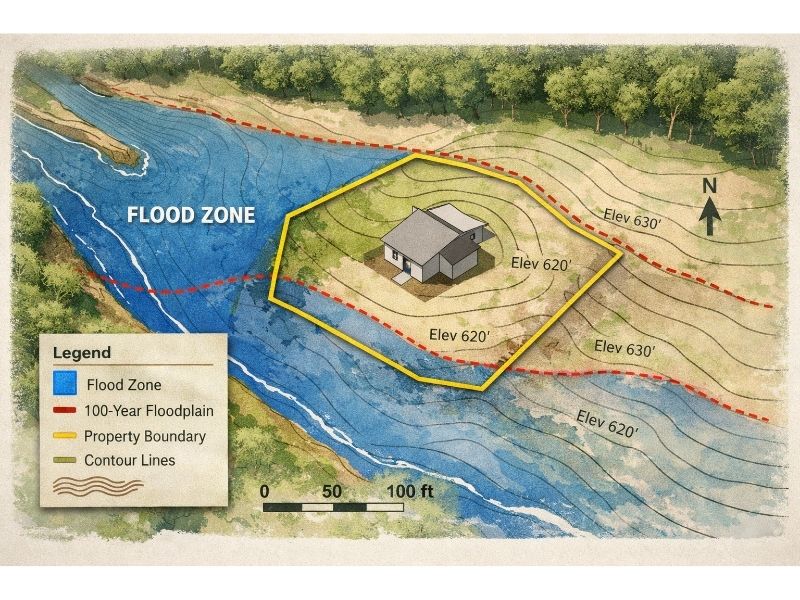
Most flood problems on a property get discovered after a purchase closes or after construction starts. By then, the options are expensive and the timeline is broken. LiDAR mapping gives property owners and developers a way to see flood risk before those decisions are made, using precise elevation data that older survey tools and public maps simply can’t match.
Why Standard Maps Fall Short for Flood Risk Decisions
Most publicly available flood maps were built with terrain data that measures elevation in 20-foot intervals. In flat areas where a single foot of grade change separates dry land from a flood path, that resolution is not enough to make sound decisions.
The problem goes beyond inaccuracy. Many official flood maps are more than 10 years old. For a large portion of the country, no detailed flood data exists at all. A parcel might sit in an area with no mapped flood zone on file, yet still drain poorly, hold standing water, or funnel runoff toward a proposed building pad.
LiDAR Data captures terrain at 1-meter resolution or finer. That’s the difference between seeing a general elevation trend and seeing exactly where water will move across a specific parcel. For a developer planning roads, grading, and stormwater systems, that level of detail changes how a site gets designed from the start.
What LiDAR Mapping Captures That Other Methods Miss
LiDAR works by firing millions of laser pulses per second from a drone or aircraft. Each pulse bounces off the ground and returns to the sensor. The time it takes to return tells the system exactly how high that point sits.
After processing, the data produces what’s called a bare earth model. Vegetation, buildings, and structures are removed from the dataset. What remains is the raw terrain surface with centimeter-level vertical accuracy.
That model reveals micro-topographic features that standard surveys and coarser contour maps miss entirely: shallow depressions, subtle drainage channels, natural flow paths, and low spots between elevated areas. For flood risk analysis, those small features matter most. A six-inch depression holds standing water after a storm. A narrow low channel between two raised areas funnels runoff directly toward a building pad. LiDAR finds those conditions before they become construction problems.
How Developers Use LiDAR Data Before Breaking Ground
Pre-development site analysis is where LiDAR mapping delivers the most value. Before a site plan gets drafted or a permit application goes in, LiDAR data answers questions that affect the entire project.
Where does water go on this site after heavy rain? LiDAR-derived terrain models show drainage flow paths across a parcel. Engineering consultants use this data to model runoff, design stormwater systems, and determine where detention or retention areas need to go. Getting this right in the design phase costs far less than correcting drainage failures after a slab is poured.
Which portions of the site carry the most flood exposure? Not every acre of a large parcel carries the same risk. LiDAR elevation data lets planners identify the lowest areas and where flood inundation could reach during a significant storm. That information drives decisions about pad elevations, building placement, and which portions of a site to keep as open space.
Does this site have drainage capacity for the proposed impervious surface? Every new building, parking lot, and driveway increases runoff. LiDAR data supports the calculations that determine whether the site can handle that load or whether it will push water onto neighboring properties.
Public LiDAR Data vs. a Site-Specific Survey
Federal and state agencies maintain publicly available LiDAR datasets for portions of the country. These are useful for early screening but carry limitations that developers and property owners need to understand before relying on them.
Public LiDAR data is typically collected at the county or watershed scale. It may be several years old. It was gathered to meet broad mapping standards, not to answer specific questions about a single parcel.
A site-specific LiDAR survey commissioned for a project captures current conditions at the density and resolution needed for engineering design and permitting. The difference between using public data and ordering a fresh survey is the difference between a general picture and a certified document you can submit to a building department.
For commercial or multifamily projects, the cost of a site-specific LiDAR survey is a small fraction of the total project budget. The data informs grading plans, drainage design, and site layout decisions that affect every dollar spent in construction. Research on high-resolution LiDAR models, including studies published in peer-reviewed hydrology journals, consistently shows substantially improved flood inundation predictions compared to coarser terrain data.
When a Property Owner Needs Site-Specific LiDAR Data
Not every property needs a commissioned LiDAR survey. Public datasets may be sufficient for an initial screening. A site-specific survey is worth ordering when:
- The parcel is large (10 acres or more) with uneven terrain or drainage complexity
- The property sits near a creek, wetland, drainage canal, or tidal feature
- A portion of the site appears on flood maps but the exact boundary is unclear
- The project involves significant grading, fill, or drainage infrastructure
- A stormwater management plan is required as part of the permitting package
- The public LiDAR data for the area is more than five years old or unavailable
For smaller parcels with flat, simple terrain in established subdivisions, a standard topographic survey usually provides enough data for site planning.
Frequently Asked Questions
How does LiDAR mapping help with flood risk assessment?
LiDAR creates high-resolution bare earth elevation models that show how water moves across a site. Engineers and planners use this data to identify low spots, drainage flow paths, and flood-prone areas before construction begins. This supports better grading design, stormwater system placement, and informed decisions about building pad elevations.
Is public LiDAR data accurate enough for site planning?
Public LiDAR datasets are useful for initial screening but are often outdated and collected at lower resolution than a commissioned survey. For projects requiring engineered drainage plans or permitting documentation, a site-specific LiDAR survey provides current, certified data suited to the project.
How accurate is LiDAR compared to older elevation data?
LiDAR captures ground elevation at resolutions of 1 meter or finer with vertical accuracy measured in centimeters. Traditional contour maps used for flood mapping measured elevation at 20-foot intervals. Peer-reviewed research has consistently shown that 1-meter LiDAR-derived terrain models produce substantially more accurate flood inundation predictions than coarser datasets.
At what project size does a LiDAR survey make sense?
For parcels of 10 acres or more, especially those with drainage complexity or proximity to water features, a site-specific LiDAR survey typically pays for itself through better site design and fewer engineering revisions. Smaller lots with simple terrain may not require one.
How long does a LiDAR survey take to complete?
Fieldwork on a drone LiDAR survey for a development site typically takes a few hours. Data processing and delivery of the elevation model and derived outputs usually follow within one to two weeks, depending on project scope.
