
Why Surveyors Rely on LiDAR Mapping Today
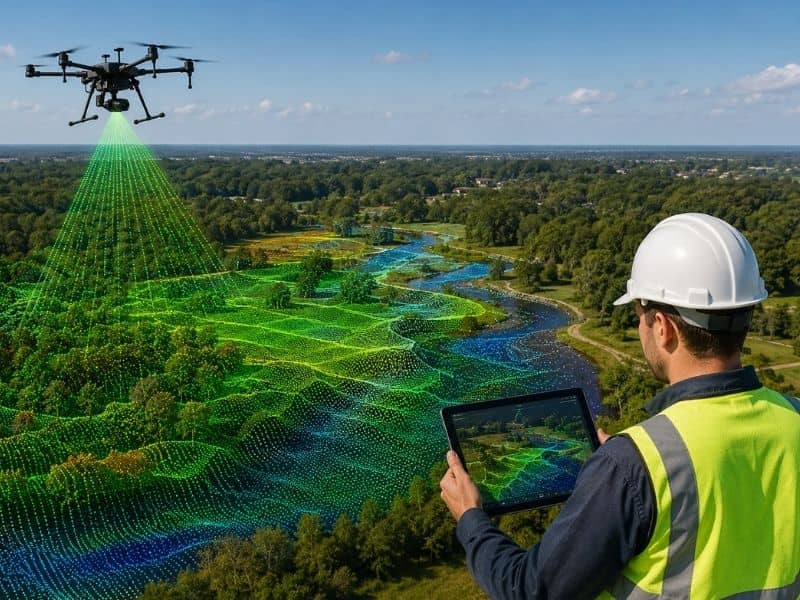
LiDAR mapping is a surveying technology that uses laser pulses to measure the exact shape and elevation of land. It creates a detailed 3D picture of the ground that is far more accurate than traditional survey methods. For homeowners, buyers, and builders, understanding LiDAR can help you make smarter decisions about your property before you spend a single dollar.
What Is LiDAR?
LiDAR stands for Light Detection and Ranging. The idea behind it is simple.
Imagine pointing a flashlight at a wall and timing how long it takes for the light to bounce back to you. If you knew the exact speed of light, you could figure out the distance to that wall down to the inch. Now imagine doing that millions of times per second from a drone or airplane flying over your property.
That is exactly what LiDAR does.
A LiDAR sensor shoots out tiny laser pulses and records how long each one takes to return. The result is a massive collection of data points called a point cloud. When those points are mapped together, they create an incredibly detailed 3D image of the land below. Think of it as a digital X-ray of the earth’s surface.
How Is LiDAR Different From Regular Aerial Photography?
A regular photo from a drone shows you what land looks like from above. But it cannot tell you exact elevations, distances, or what is hiding under tree cover.
LiDAR can.
Because laser pulses pass through small gaps in tree branches, LiDAR can see the ground even underneath a thick forest. This is especially useful in Jacksonville, where wetlands, dense tree cover, and heavy vegetation make traditional aerial photos unreliable.
A standard photo might show you a flat green lawn. A LiDAR scan of that same lawn could reveal a hidden drainage ditch, a slope you cannot see with your eyes, or a low-lying area that floods during heavy rain.
How Does a LiDAR Survey Work?
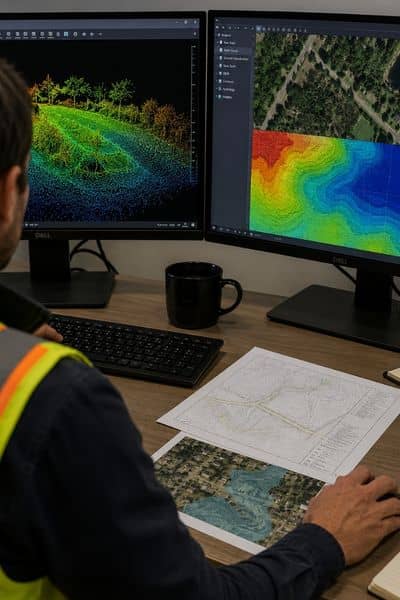
Here is a simple breakdown of what happens during a LiDAR survey.
Step 1. Data Collection A plane or drone with a LiDAR sensor flies over the area. The sensor fires millions of laser pulses toward the ground and records the data in real time.
Step 2. Point Cloud Processing All the data points are downloaded and processed using specialized software. The result looks like a dense map made of millions of tiny dots, each one showing an exact location on the earth’s surface.
Step 3. Ground Filtering The software separates ground points from everything else like trees, buildings, and power lines. What remains is called a bare earth model. This shows the true shape of the land with nothing on top of it.
Step 4. Final Deliverables From the bare earth model, surveyors can produce topographic maps, elevation profiles, and flood models. This data is then used to make important decisions about your property.
Why Does LiDAR Matter for Homeowners?
Jacksonville is flat. Much of the city sits just a few feet above sea level. With the St. Johns River, countless creeks, and frequent heavy rainfall, elevation matters more here than in most Florida cities.
Even a difference of one foot in elevation can determine whether your property falls inside a FEMA flood zone. That one foot can mean the difference between paying $500 a year in flood insurance and paying $3,000 or more.
Old survey methods used measuring tapes and manual calculations. They were accurate enough for their time but could not capture the full picture of a large piece of land quickly or at a low cost.
LiDAR changes that. It can map hundreds of acres in a single afternoon with accuracy down to a few centimeters. That level of detail gives you a much clearer picture of what you are buying or building on.
Real Situations Where LiDAR Helps Property Owners
Buying a home near a flood zone. LiDAR data shows the exact elevation of your property. If FEMA’s flood maps were made using older, less accurate data, a licensed surveyor can use LiDAR measurements to challenge your flood zone designation and potentially lower your insurance costs.
Planning to build a home or addition. Before construction begins, builders need to know how water moves across the land. LiDAR drainage maps show exactly where water flows during heavy rain, preventing costly mistakes like building in a spot that floods every summer.
Buying rural land. Walking every inch of raw land in North Florida is slow and sometimes dangerous. LiDAR surveys let surveyors map large tracts quickly and accurately, even through thick brush that is hard to reach on foot.
Resolving a property dispute. When neighbors disagree about where a property line falls, precise data from a LiDAR-assisted survey can provide clear and defensible evidence.
Does LiDAR Replace a Traditional Land Survey?
No, and this is important to understand.
LiDAR is a powerful tool that licensed surveyors use. It does not replace the surveyor. In Florida, only a licensed Professional Surveyor and Mapper can legally certify boundary lines, sign off on elevation certificates, or provide survey data that holds up in court or before a government agency.
Think of LiDAR like a stethoscope. It is a great tool, but it only means something in the hands of a trained professional. When you hire a surveying company that uses LiDAR, you get cutting-edge technology and a licensed expert who knows how to certify what the data shows.
Frequently Asked Questions
What is LiDAR mapping used for in land surveying?
LiDAR mapping measures land elevation, creates topographic maps, identifies flood risks, and supports boundary surveys. In Jacksonville, even small elevation differences can affect your flood zone status and insurance costs.
Is LiDAR more accurate than a traditional survey?
For large-area elevation mapping, LiDAR is faster and more detailed than traditional methods. That said, a licensed surveyor must still review and certify the data for it to be legally valid.
How does LiDAR affect my flood insurance?
A LiDAR-based survey can show that your property sits higher than FEMA’s maps recorded. That difference in elevation can lead to a flood zone reclassification and a much lower insurance premium.
How long does a LiDAR survey take?
Data collection for most residential properties takes just a few hours. Final maps and reports are typically delivered within a few days to a week.
