How to Read a Topographic Survey
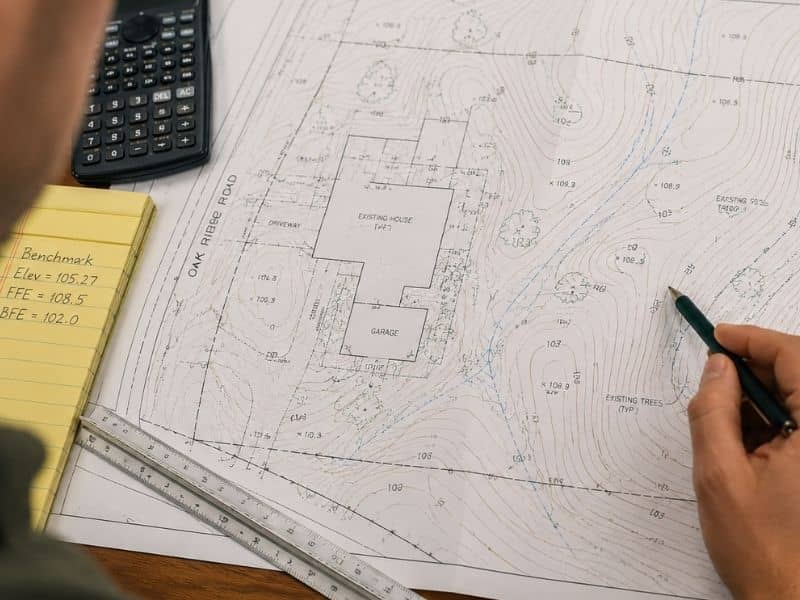
You paid for a topographic survey. The PDF lands in your inbox. You open it and suddenly you are staring at something that looks like a weather map mixed with a maze.
Your contractor says everything looks fine. Your engineer starts talking about grades, contours, and elevations. Meanwhile, you are wondering what any of it actually means.
That happens to many property owners. However, learning how to read a topographic survey can save you thousands of dollars in drainage problems, permit delays, and flood-related repairs later.
Jacksonville is one of the flattest major cities in Florida. Because of that, even small elevation changes can affect how water drains across your property. A few inches can decide whether your yard drains properly or floods during heavy rain.
The good news is that reading a topographic survey becomes much easier once you understand what the lines, numbers, and symbols mean.
What a Topographic Survey Shows
A topographic survey shows the elevation, slopes, drainage patterns, and physical features of a property. In Jacksonville, even small elevation changes can affect flood risk, drainage performance, and permit approval. Reading a topographic survey correctly helps property owners understand how water moves across their land before construction begins.
A topographic survey, often called a topo survey, shows the shape of the land.
It maps:
- slopes
- low spots
- hills
- drainage paths
- structures
- utilities
- natural features
The survey turns real land into a flat drawing that engineers, contractors, and property owners can read.
Every line and number on the survey represents something real on your property.
Topographic surveys matter because much of the area sits only a few feet above sea level. According to FEMA flood maps, many parts of Duval County fall within flood-prone areas near rivers, creeks, and wetlands.
That means your topo survey is not just showing land elevation. It is also showing how water may move during heavy rain.
How to Read Contour Lines on a Topographic Survey
Contour lines connect points of equal elevation across a property. Lines spaced closely together show steeper slopes, while lines farther apart indicate flatter ground. In Jacksonville, contour lines help identify drainage flow, low spots, and grading issues that may affect permits, flood risk, or future construction projects.
The curved lines covering most of your topo survey are called contour lines.
Each contour line connects points that sit at the same elevation.
These lines help show how the ground rises and falls across your property.
You will usually see two types of contour lines:
- Index contours — thicker lines with elevation numbers
- Intermediate contours — thinner lines between the labeled contours
The space between the lines is called the contour interval. In Jacksonville, surveyors often use a 0.5-foot or 1-foot interval because the land is so flat.
Quick Guide to Reading Contour Lines
- Lines close together = steeper slope
- Lines far apart = flatter land
- V-shaped contours = drainage channel
- Closed loops = raised or low ground
- Lower elevation numbers = lower land elevation
Large areas of Jacksonville have very small elevation changes. Because of that, contour lines are important for spotting drainage problems before construction starts.
If the contour lines show water flowing toward your house instead of away from it, your engineer may need to adjust the grading plan.
Understanding Elevation Numbers on a Topo Survey
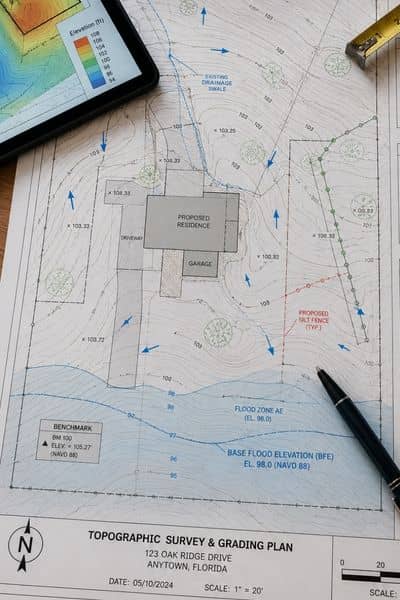
Elevation numbers on a topographic survey show the height of the land above mean sea level. Surveyors typically use NAVD 88 elevation standards. These numbers help determine flood insurance requirements, finished floor elevations, drainage compliance, and whether a property sits above or below FEMA flood zone levels.
Every elevation number on your survey shows the height of the land above sea level.
Most surveyors use a standard called NAVD 88. You do not need to remember the name, but it helps keep elevation measurements accurate and consistent.
One of the most important elevation numbers on your property is the Base Flood Elevation, also called the BFE.
FEMA assigns BFEs throughout Duval County to show how high floodwater could rise during a major storm.
Why Base Flood Elevation Matters
- Homes below BFE often pay higher flood insurance costs
- Homes above BFE may qualify for lower insurance rates
- Elevation affects permit approval
- Finished floor height matters during construction planning
In Jacksonville, some neighborhoods sit only inches above or below their assigned BFE.
That small difference can affect insurance costs and flood risk.
How Drainage Arrows Predict Water Flow Problems
Drainage arrows on a topographic survey show the direction stormwater flows across a property during rainfall. In Jacksonville, understanding drainage direction is important because new driveways, pools, and additions can redirect water toward homes, neighboring lots, or low areas that flood easily.
Some topo surveys include small arrows showing how water moves across the property during rain.
These drainage arrows are important before starting construction.
Adding a driveway, pool, patio, or room addition changes how water flows across your lot. If the project redirects water toward your home or your neighbor’s property, it can create serious drainage problems.
Jacksonville receives heavy rain during hurricane season and strong summer storms. Because of that, drainage planning is a major part of many construction projects.
The St. Johns River Water Management District reviews drainage impacts for many developments in Northeast Florida. Missing drainage information can slow down permit approval.
Before construction starts, check:
- where water currently flows
- where low spots exist
- whether runoff moves toward structures
- whether nearby construction could affect drainage
Your topo survey creates a record of existing drainage conditions before changes happen.
Common Symbols Found on a Topographic Survey
Topographic surveys use symbols to identify spot elevations, utilities, easements, wetlands, protected trees, and benchmark locations. These symbols help engineers, contractors, and property owners understand site restrictions, environmental concerns, and construction limits before starting a project.
Topo surveys include more than contour lines and elevation numbers.
They also contain symbols that show important property features.
Spot Elevations
X marks with numbers are called spot elevations.
These points show the exact elevation at one specific location.
Engineers use them when making detailed grading decisions.
Easements and Underground Utilities
Dashed lines often represent:
- utility easements
- underground pipes
- drainage areas
- access easements
These areas may limit where you can build.
Building over utilities or easements can create expensive problems later.
Wetland Boundaries
Hatched or shaded areas often mark wetlands or environmental buffers.
Jacksonville contains many wetland areas throughout Duval County. Building near wetlands may require special permits and setbacks.
Tree Symbols
Tree symbols often include trunk diameter numbers.
Jacksonville protects certain trees under local rules. Protected trees can affect where you place:
- pools
- fences
- patios
- additions
- driveways
Benchmark (BM) Notation
BM stands for benchmark.
This is the fixed reference point surveyors use to calculate elevations across the property.
When Property Owners Need a Topographic Survey
Property owners often need topographic surveys before building pools, additions, drainage systems, or new structures. Topographic data is commonly required for grading permits, floodplain reviews, stormwater planning, and environmental permits throughout Duval County.
Many people do not think about topo surveys until permits become part of the project.
However, topo surveys are often required earlier than expected.
Building a Pool
Pool permits often require drainage review.
Your topo survey helps show how water will move after construction.
Adding an Addition or ADU
Home additions and accessory dwelling units often trigger grading and drainage reviews.
Elevation differences around the structure affect permit approval.
Buying Raw Land
Vacant land may look buildable from the road.
However, a topo survey may reveal:
- flood-prone areas
- drainage channels
- wetlands
- grading issues
- utility restrictions
These issues can increase development costs.
Environmental Resource Permits
Incomplete topographic information is one of the most common reasons permit reviews get delayed.
Accurate topo data helps reduce problems during the approval process.
Common Mistakes Homeowners Make When Reading a Topographic Survey
Many homeowners misunderstand contour intervals, confuse boundary surveys with topographic surveys, or ignore FEMA flood elevation comparisons. These mistakes can lead to drainage problems, permit delays, redesign costs, and higher flood insurance expenses.
Even homeowners who study their surveys carefully can still miss important details.
Here are some common mistakes.
Confusing Boundary Surveys With Topographic Surveys
A boundary survey shows property lines.
A topographic survey shows the shape and elevation of the land.
Many projects need both surveys.
Ignoring the Contour Interval
Always check the contour interval listed on the survey.
A 2-foot interval on flat land may miss drainage issues that a 0.5-foot interval would show clearly.
Assuming Only Engineers Need the Survey
Your contractor and engineer will use the topo survey often.
However, property owners should understand it too because they are the ones living with the final results.
Not Comparing Elevation Data With FEMA Flood Maps
Your topo survey shows elevation numbers.
FEMA maps show flood zones and Base Flood Elevation data.
Comparing the two helps you understand flood risk more clearly.
Your Topographic Survey Is Telling You Something Pay Attention
Many property owners treat a topographic survey like complicated paperwork.
In reality, it contains valuable information that affects drainage, flood risk, construction costs, permitting, and long-term property protection.
The contour lines show how your land rises and falls.
The elevation numbers show how your property compares to flood levels.
The drainage arrows show where stormwater flows during heavy rain.
And the symbols identify site conditions that could affect your project later.
In a flat and flood-prone city like Jacksonville, understanding your topo survey is one of the best ways to avoid expensive problems before construction begins.
